

The Third Paradigm in Sealing: Translucent Peroxide-Cured Encapsulated Systems
Executive Summary: Disrupting the “Red vs. Clear” Dichotomy
For decades, industrial processing in pharmaceutical and semiconductor sectors has faced a binary choice in sealing: select Platinum-Cured Silicone for purity and clarity, or Peroxide-Cured Silicone for mechanical robustness and thermal stability.
Historically, choosing peroxide meant accepting the “Red Box”—opaque material pigmented with iron oxide heat stabilizers that hid internal defects. Choosing platinum meant dealing with high costs and volatile “pot life” during manufacturing.
The “Third Paradigm” is here. M-Cor has developed a Translucent Peroxide-Cured Encapsulated O-Ring. This innovation utilizes advanced non-pigmented stabilizers to achieve the optical clarity of platinum while retaining the processing stability of peroxide.
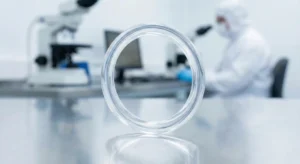
A translucent peroxide-cured O-ring in a cleanroom environment, demonstrating its high optical clarity.
This webpage explores why this material is the strategic “secondary choice” that frequently outperforms the primary option.
Core Advantages: Why Switch to Translucent Peroxide?
1. The “Glass Cockpit” Advantage: Visual Inspectability
In high-stakes environments, you cannot afford a “Black Box” seal. Traditional red peroxide silicone hides internal failures. M-Cor’s translucent core creates a “Glass Cockpit” for your maintenance team.
-
Detect Defects Early: Easily see air bubbles, voids, or contaminants trapped in the core during the manufacturing or installation process.
-
Monitor Seal Health: A crack or “Compression Set Fracture” inside the core scatters light, appearing as a bright fissure. This allows for condition-based maintenance rather than guessing.
-
Breach Indication: If the encapsulation jacket is breached and colored process fluid enters, the clear core will take on that color, serving as an immediate visual alarm.
2. Solving the Manufacturing “Pot Life” Crisis
One of the most critical failures of platinum systems is the volatility of the two-part mixing process. Platinum systems rely on mixing Part A and Part B immediately before extrusion. Once mixed, the chemical clock starts ticking.
The Platinum Problem:
-
Short pot life leads to “creeping viscosity.”
-
Risk of material curing (gelling) inside the extruder if the line stops.
-
Inconsistent dimensional tolerances in long-run extrusions.
The M-Cor Peroxide Solution:
Our Translucent Peroxide system utilizes High Consistency Rubber (HCR) that is pre-compounded. Because peroxide systems require high activation temperatures (typically over 115°C) to kick off, the material remains shelf-stable at room temperature for weeks.
-
No “Part A/B” Mixing On-Site: Eliminates mixing errors and variability.
-
Continuous Extrusion: Allows for long, uninterrupted production runs with consistent rheology and perfect dimensional control.
-
Scorch Safety: High thermal safety margins prevent premature curing in the screw, ensuring a defect-free core.
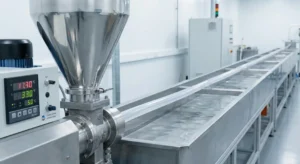
A continuous extrusion line producing translucent silicone cord, illustrating the long-run capability and material stability.
3. The “Firewall” Encapsulation
The translucent peroxide core is enveloped in a seamless fluoropolymer jacket, creating a functional barrier that upgrades the purity classification of the seal.
-
Blocking Ingress: The jacket protects the silicone core from chemical attacks (solvents, acids) that would typically swell or dissolve bare rubber.
-
Blocking Outgassing: The jacket acts as a containment shield, trapping any volatile byproducts (like organic acids) inherent to peroxide curing. This prevents them from leaching into your sensitive process fluids.
Material Technology: FEP vs. PFA Jackets
The “Third Paradigm” core can be paired with two distinct jacket materials, both optically clear to maintain inspectability.
| Feature | FEP (Fluorinated Ethylene Propylene) | PFA (Perfluoroalkoxy) |
| Primary Use | Standard Static Sealing | High-Performance / Semiconductor |
| Thermal Limit | Service up to 204°C | Service up to 260°C |
| Mechanicals | Excellent stiffness, low friction | Superior flex-life and thermal retention |
| Purity | High chemical inertness | Ultra-low extractables (UPW grade) |
Technical Comparison: Platinum vs. Translucent Peroxide
Is the Translucent Peroxide system right for your application? Compare the metrics below.
| Metric | Platinum Cured (Primary) | Translucent Peroxide (M-Cor) | Strategic Takeaway |
| Optical Clarity | High | High (Translucent) | Both allow for visual quality assurance. |
| Supply Chain | Volatile (Precious metal pricing) | Stable (Organic initiators) | Peroxide offers cost stability and availability. |
| Manufacturing | Sensitive (Short pot life) | Robust (Long shelf life) | Peroxide ensures better dimensional consistency for long extrusions. |
| Compression Set | 20-30% | ≤ 35% | Peroxide HCR is legendary for memory; virtually identical performance in encapsulated formats. |
Strategic Applications
This technology is validated for use where visual inspection and supply chain reliability are paramount, but where the extreme cost of platinum may not be justified.
-
Pharmaceutical Manufacturing: Transfer lines and hygienic unions where visual fluid verification is required.
-
Semiconductor Fabrication: Wet bench processing where “Red” silicone is forbidden due to metal oxide contamination risks.
-
Bioprocess Engineering: Long-run fluid paths where seal integrity must be verified without disassembly.
Conclusion: The Validated Alternative
M-Cor’s Translucent Peroxide-Cured Encapsulated O-Ring is not just a cost-saving alternative; it is a technically superior choice for manufacturing consistency. By eliminating the iron oxide “black box” and the platinum “pot life” constraints, this product offers the ideal balance of purity, inspectability, and reliability.
Copyright: M-Cor Inc