
Encapsulated O-Ring Tolerances
Why cut-to-length encapsulated O-rings do not behave like molded AS568 rubber O-rings.
Encapsulated O-ring tolerances differ from molded elastomer O-ring tolerances. Therefore, engineers, buyers, and inspection teams should understand how these parts are manufactured, measured, and evaluated before applying a molded rubber standard.
At first, an encapsulated O-ring may look like a standard O-ring. However, many encapsulated seals are produced through a cut-to-length, forming, and welding process. As a result, dimensional expectations must account for material behavior, thermal expansion, weld construction, and measurement method.
For this reason, M-Cor provides practical tolerance guidance and request-based access to detailed tolerance documentation.
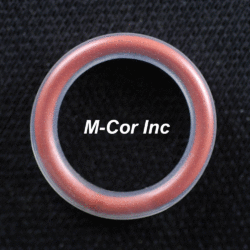
The Reality of Encapsulated O-Ring Tolerance
Encapsulated O-rings are not always molded components. Instead, many are produced by forming fluoropolymer tubing around an elastomer core and joining the material to create a continuous seal.
Consequently, the tolerance logic is different. Molded O-rings are controlled by mold-defined geometry. However, many encapsulated O-rings are controlled by cut length, forming behavior, weld technique, material recovery, and inspection method.
In addition, M-Cor’s in-house material and extrusion control helps support better dimensional consistency. Because core behavior affects finished geometry, controlling the material of construction before the final seal is formed gives M-Cor a stronger manufacturing foundation.
Therefore, applying AS568 molded O-ring tolerances to encapsulated products may create unrealistic expectations and unnecessary rejection of functional parts.
RMA vs. AS568 Tolerances
RMA-Based Tolerance Logic
Encapsulated O-rings generally follow RMA-style cut-length tolerance logic. In many cases, length variation is converted into inside diameter tolerance through geometric relationships.
AS568 Molded O-Ring Logic
AS568 tolerances apply to molded elastomer O-rings. Therefore, they should not be applied directly to cut-to-length encapsulated sealing products without understanding the manufacturing method.
As a result, a fair inspection plan should match the product type. Otherwise, a usable encapsulated O-ring may be rejected because it was judged under the wrong tolerance expectation.
Measurement Considerations
Accurate measurement requires more than one quick diameter check. In fact, the measurement method can strongly influence the result.
FEP and PFA have higher coefficients of thermal expansion than many metals and molded elastomers. Therefore, even small temperature changes may produce measurable dimensional movement.
In addition, encapsulated O-rings may show slight ovality before installation. However, once installed, sealing force and groove geometry help restore the functional shape.
- Radial measurements alone may not show true functional geometry.
- Axial compression can influence final installed dimensions.
- Measurement equipment and technique can change readings.
- Environmental conditions can affect dimensional results.
- Installed function should be considered with free-state measurement.
Practical Engineering Expectations
Claims of extremely tight inside diameter tolerance on large FEP or PFA encapsulated O-rings often ignore material behavior.
While tighter groupings may be achieved through post-production sorting, these groupings should not automatically be treated as standard manufacturing tolerance. Instead, engineers should separate normal manufacturing tolerance from special sorting or application-specific inspection.
Consequently, aligning expectations with engineering reality reduces unnecessary inspection disputes and supports better sealing decisions.

M-Cor Approach to Tolerance Transparency
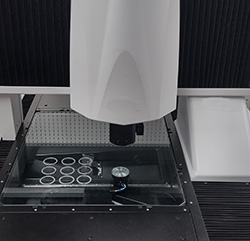
M-Cor takes a data-driven approach to encapsulated O-ring tolerance. First, the material of construction is considered. Next, the part construction and manufacturing method are reviewed. Then, the finished part is measured, documented, and evaluated using precision inspection systems.
In addition, M-Cor provides customers with clear guidance on tolerance expectations and application-specific performance. As a result, engineers can specify encapsulated seals with more confidence.
Finally, this transparency helps reduce the uncertainty often associated with encapsulated sealing solutions, especially where buyers compare cut-to-length products against molded O-ring standards.
Access Detailed Tolerance Data
Detailed tolerance charts, dimensional data, and application-specific guidance are available upon request.
These resources include expanded RMA-based tolerance ranges, practical measurement guidance, and real-world dimensional considerations for encapsulated O-rings.
Therefore, if your application requires tighter review, request access to the detailed tolerance specs page. Password access may be required.
Frequently Asked Questions
Do encapsulated O-rings meet AS568 tolerances?
Encapsulated O-rings generally follow RMA-based cut-length tolerance logic because many are produced through forming, cutting, and welding rather than standard rubber molding. However, when requested we can manufacture to RMA L1 which is tighter than AS568
Why do dimensional measurements vary?
Material flexibility, thermal expansion, ovality, measurement method, and environmental conditions can all influence dimensional readings. Therefore, measurement method matters.
Can tighter tolerances be achieved?
In some cases, tighter groupings may be achieved through sorting or special inspection. However, these results should not be confused with standard manufacturing tolerance.
Why does installation matter?
Installation affects final function. As a result, groove geometry, compression, handling, and seal placement should be considered along with free-state measurements. See M-Cor’s installation advice.
Need Encapsulated O-Ring Tolerance Guidance?
When an encapsulated O-ring is used in a critical application, tolerance should be specified with the manufacturing method in mind.
Therefore, if quality, dimensional control, and documented measurement matter, contact M-Cor before the wrong tolerance assumption creates inspection problems or unnecessary rejection.