
Large Diameter Encapsulated O-Rings U.S. Made
Controlled cut lengths, dimensional inspection, and documented tolerance guidance for oversized static seals.
Large diameter encapsulated O-rings present unique manufacturing and inspection challenges. As diameter increases, dimensional variation, free-state geometry, handling, and thermal movement become more important.
Therefore, M-Cor controls more than the final diameter. We review the material of construction, core consistency, cross section, calculated cut length, weld, handling method, inspection plan, and application requirements before the seal is released.
Since 1987, M-Cor has manufactured FEP and PFA encapsulated sealing products in the United States. In addition, key elastomer materials and precision extrusions are manufactured in-house. This reduces dependence on outside vendors and improves control before the large O-ring is formed.
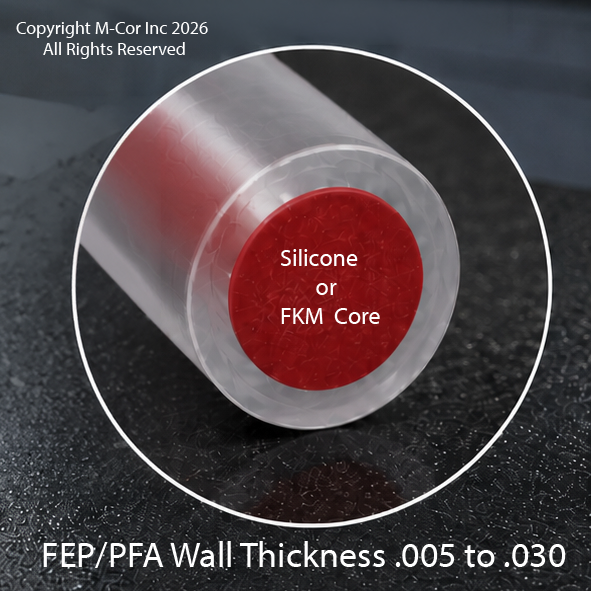
Large FEP and PFA encapsulated O-rings require controlled construction, handling, measurement, and tolerance communication.
U.S. Manufacturing
Large diameter encapsulated O-rings are manufactured by M-Cor in the United States.
In-House Material Control
Key elastomer materials and precision core extrusions are controlled closer to the source.
Custom Diameters
Nonstandard inside diameters and cross sections can be reviewed for manufacturing feasibility.
Inspection Options
Dimensional inspection and reporting can be quoted when the requirement is defined before production.
The Challenge with Large Diameter Encapsulated O-Rings
Large encapsulated O-rings are not simply enlarged versions of small molded rubber O-rings. Instead, most nonstandard large rings are produced through controlled cut-to-length, forming, and welding processes.
Consequently, the final geometry reflects more than a mold cavity. Cut-length variation, core behavior, jacket stiffness, welding, handling, storage, part relaxation, and measurement method can all influence the free-state result.
Greater Absolute Variation
As diameter increases, the same percentage of length variation creates a larger absolute dimensional difference. Therefore, tolerance must be discussed in practical terms.
Free-State Ovality
Large rings may show temporary out-of-round geometry after forming, packing, or handling. However, a single-axis reading may not describe the functional installed geometry.
Thermal Expansion
FEP, PFA, and elastomer cores respond to temperature differently. As a result, measurement temperature and operating temperature must be considered during design and inspection.
Do not apply molded O-ring assumptions without review
AS568 molded-rubber tolerances should not be applied automatically to a large cut-to-length encapsulated O-ring. Instead, the drawing, manufacturing method, measurement method, and functional gland requirement should be aligned before the order is placed.
Our Approach to Large Diameter Precision
Precision begins before the O-ring is formed. For this reason, M-Cor reviews the application, controls key material inputs, calculates the required length, and establishes the inspection plan in the proper order.
1. Application Review
First, we review diameter, cross section, material, temperature, media, pressure, groove design, installation, tolerance, and documentation needs.
2. Material Control
Next, key elastomer core dimensions and material behavior are controlled. Therefore, final geometry does not depend only on an outside supplier’s standard extrusion.
3. Cut-Length Calculation
Then, M-Cor calculates the centerline circumference and applies the process controls required for forming, welding, and material behavior.
4. Geometric Inspection
Finally, the finished ring is evaluated against the agreed inspection method. Optional reporting can be supplied when it is included in the quote.
Inspection methods should match the requirement
Depending on diameter and specification, M-Cor may use circumference-based calculations, mean-diameter relationships, multiple-axis measurements, visual coordinate measurement, or other defined inspection methods.
In addition, the inspection plan can identify temperature, relaxation time, measuring support, allowable ovality, cross section, and required reporting. This prevents the supplier and customer from using different methods after production.
- Defined inside diameter or mean diameter requirement
- Defined cross-section requirement
- Defined measurement temperature and method
- Defined free-state or installed-functional expectation
- Defined documentation and reporting requirement
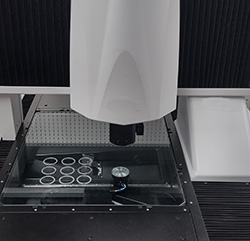
A defined measurement method is especially important when a large ring can relax, shift, or appear oval in its free state.
Large Diameter Geometry, Ovality, and Measurement
A large encapsulated O-ring can be functionally correct even when its unsupported free-state shape is not a perfect circle. Therefore, the inspection method should evaluate the dimension that controls the installed seal.
Free-State Geometry
Packaging, forming stress, gravity, handling, and storage can influence the unsupported ring shape. Consequently, one radial measurement may not represent the full circumference.
Installed Functional Geometry
Once the ring is seated evenly in the gland, groove geometry and compression help establish its functional shape. However, the gland must be designed for the actual seal construction.
Useful geometric relationships
Mean Diameter = Inside Diameter + Cross Section Nominal Centerline Circumference = π × Mean DiameterThese relationships provide a geometric starting point. However, manufacturing allowances, material behavior, weld construction, relaxation, and the agreed inspection method must still be considered.
Specify the method, not only the number
A tight tolerance without a defined measurement method can create disagreement even when the part functions correctly. Therefore, the drawing or purchase requirement should state how the large diameter will be measured and what condition the part must meet.
Material Options for Large Diameter Encapsulated O-Rings
Jacket and core materials must be selected together. The jacket provides the primary process-contact barrier, while the elastomer core provides compression, recovery, and sealing force.
FEP Encapsulated O-Rings
FEP provides broad chemical resistance and is often the cost-effective choice for many static sealing applications. In addition, its lower stiffness can help with handling and installation in some large-diameter designs.
Finished-seal limits depend on the core, media, pressure, groove, installation, and application conditions.
PFA Encapsulated O-Rings
PFA is often selected when the application requires higher temperature capability, improved creep resistance, or more demanding process conditions. However, PFA can be stiffer and may require additional installation planning.
Finished-seal limits depend on the complete construction and actual service conditions.
Silicone Core
Silicone cores provide flexibility, recovery, and broad temperature behavior. Therefore, they are commonly considered when installation flexibility and low-temperature response are important.
FKM / Viton® Core
FKM cores may provide improved compression-set behavior and compatibility for selected chemical services. In contrast, they are generally less flexible than silicone during difficult large-ring installation.
External Reference: Teflon™ FEP Resins
Review the fluoropolymer manufacturer’s general FEP resin properties and material information.
External Reference: Teflon™ PFA Resins
Review the fluoropolymer manufacturer’s general PFA resin properties and material information.
Applications for Large Diameter Encapsulated Seals
Large diameter encapsulated O-rings are commonly considered where a broad sealing circumference must resist aggressive media while maintaining elastic recovery.
Semiconductor Chambers
Large chamber and process-equipment seals may require chemical resistance, controlled geometry, high-purity materials, and documented inspection.
Vacuum and Low-Pressure Systems
Vacuum applications require review of permeability, core resilience, compression, jacket wall, thermal cycling, and groove design.
Chemical Processing Equipment
Large flanges, vessels, reactors, and process housings may use FEP or PFA jackets to protect the elastomer core from aggressive process media.
Filtration Housings
Large housings may require a continuous chemical-resistant sealing surface, predictable compression, and careful installation around a broad circumference.
Pharmaceutical and Bioprocess Equipment
Selected large process seals may require material documentation, clean contact surfaces, controlled handling, and application- specific compliance review.
Selected Aerospace and Research Systems
Large static seals may be reviewed for selected aerospace, vacuum, test, and research equipment. However, each application requires independent qualification.
Large Diameter Seals Are Not Commodity Parts
The lowest quoted price may look attractive. However, a small percentage of variation across a large circumference can become a significant dimensional difference. Therefore, material control, cut-length calculations, handling, inspection, and documentation cannot be separated from price.
When those controls are reduced, the buyer may save a little upfront and pay much more later through receiving disputes, rework, delayed installation, repeat failure, downtime, and lost trust.
The choice is direct: pay a little more for specified and documented quality, or risk paying more later when a low-priced commodity seal does not meet the real requirement.
Protect Uptime
A correctly specified seal reduces the chance that a dimensional misunderstanding becomes an equipment problem.
Protect Your Reputation
Buyers and distributors are judged by whether the supplied part works, not only by the original purchase price.
Protect Repeat Business
Clear tolerances, inspection, and source accountability support confidence when the same large seal must be ordered again.
Why Specify M-Cor for Large Diameter Encapsulated O-Rings?
M-Cor combines long-term encapsulated O-ring manufacturing experience with in-house material control, custom sizing, dimensional inspection, and direct tolerance communication.
- Encapsulated sealing manufacturing experience since 1987
- U.S.-based manufacturing without offshore production
- In-house control of key elastomer materials and extrusions
- Custom inside diameters and cross sections
- FEP and PFA jacket options
- Silicone, FKM/Viton®, hollow, and specialty core options
- Defined measurement and tolerance guidance
- Optional inspection and documentation support
- Direct application review before production

M-Cor emphasizes manufacturing reality, defined tolerance expectations, dimensional inspection, and source accountability.
What to Provide for a Large Diameter O-Ring Quote
A complete request helps M-Cor review feasibility and recommend the correct construction without unnecessary delays.
Required Dimensions
Provide inside diameter, outside diameter or mean diameter, cross section, dimensional units, and the applicable tolerance.
Material Construction
Identify FEP or PFA jacket preference and silicone, FKM/Viton®, hollow, or specialty core requirements.
Operating Conditions
State process media, concentration, temperature, pressure, vacuum level, thermal cycling, and expected service conditions.
Gland and Installation
Include groove dimensions, mating hardware, required stretch, surface condition, access limitations, and installation method.
Quantity and Schedule
Provide prototype quantity, annual usage, requested delivery, and whether recurring production is expected.
Inspection and Documentation
Identify dimensional reports, certificates, material documentation, serialization, or special inspection before quotation.
Large Diameter Encapsulated O-Ring Design Resources
Continue with these M-Cor pages when your application requires deeper material, tolerance, installation, or measurement guidance.
Encapsulated O-Rings
Review M-Cor’s complete FEP and PFA encapsulated O-ring product family, core options, applications, and engineering resources.
Encapsulated O-Ring Tolerances
Learn why cut-to-length encapsulated O-ring tolerances differ from molded-rubber tolerance expectations.
Coefficient of Thermal Expansion
Review how temperature changes can affect the jacket, core, dimensions, groove loading, and sealing performance.
FEP vs. PFA
Compare flexibility, creep behavior, mechanical performance, temperature capability, and cost.
Installation Advice
Review groove preparation, heating, stretching, handling, lubrication, compression, and final inspection guidance.
Encapsulated O-Ring FAQ
Find concise answers about materials, tolerances, installation, shelf life, applications, documentation, and failure prevention.
Large Diameter Encapsulated O-Ring FAQ
What qualifies as a large diameter encapsulated O-ring?
There is no single universal cutoff. M-Cor treats larger nonstandard diameters as application-specific because handling, cut length, geometry, tolerance, inspection, and installation become increasingly important as size grows.
Are large diameter encapsulated O-rings molded?
Most nonstandard large diameter encapsulated O-rings use cut-to-length, forming, and welding processes rather than a conventional molded-rubber O-ring process.
Why can a large ring appear out of round?
Forming stress, gravity, handling, packaging, storage, and relaxation can affect free-state shape. Therefore, one radial reading may not represent the full circumference or installed geometry.
How should a large diameter O-ring be measured?
The correct method depends on the drawing and application. Circumference, mean diameter, multiple-axis measurements, cross section, temperature, support, and relaxation time may need to be defined.
Can M-Cor provide tighter dimensional groupings?
In some cases, M-Cor can review special process controls, measurement, sorting, or inspection reporting. However, those requirements must be defined and quoted before production.
Should I choose FEP or PFA for a large diameter seal?
Choose the jacket after reviewing media, temperature, pressure, creep, installation, flexibility, purity, and cost. FEP often offers greater flexibility and lower cost, while PFA supports higher-temperature and more demanding service.
Can large diameter encapsulated O-rings be used in vacuum?
They may be considered for vacuum applications. However, permeability, core material, jacket thickness, compression, thermal cycling, and groove design require application review.
What information does M-Cor need for a quote?
Provide dimensions, tolerance, FEP or PFA jacket, core material, quantity, media, temperature, pressure, groove information, installation details, and required inspection documentation.
Request a Large Diameter Encapsulated O-Ring Quote
Provide the required diameter, cross section, jacket, core, quantity, application conditions, tolerance, installation details, and inspection requirements. Then M-Cor can review feasibility and recommend the appropriate construction.
Therefore, contact M-Cor before a large diameter tolerance, measurement, material, or installation assumption becomes an expensive production problem.
Call: 406-227-0477 | Email: customerservice@m-cor.com