
Understanding Hardness in Encapsulated O-Rings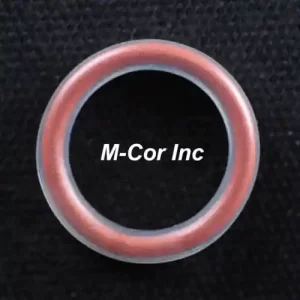
An encapsulated O-ring isn’t one solid material. It’s a combination of:
- Fluoropolymer jacket (FEP or PFA) that provides chemical resistance.
- Elastomer core (Silicone or FKM/Viton) that gives the ring its elasticity.
When you measure hardness with a durometer, the reading mostly reflects the outer fluoropolymer shell, not the soft inner core.
That’s why encapsulated O-rings often show higher “apparent” hardness values than their cores would suggest.
Why This Matters
- The fluoropolymer jacket’s modulus (stiffness) and wall thickness dominate the overall feel.
- The elastomer core hardness mainly affects rebound and recovery—how the ring behaves in service, not what a durometer reads.
- Two O-rings with identical cores can feel very different if their jacket material or wall thickness changes.
Comparative Modeling Guide
| Jacket Type | Modulus (MPa) | Wall Thickness (in) | Core Type | Core Hardness (Shore A) | Approx. Apparent Ring Hardness | Typical Application Notes |
|---|---|---|---|---|---|---|
| Low-Modulus PFA | 200–300 | 0.008 | Silicone | 60 | ~80 ShA | Very soft response; best for low-load or fragile flanges |
| Silicone | 70 | ~85 ShA | Balanced elasticity and sealing | |||
| Silicone | 90 | ~90 ShA | Firmer feel; higher compression-set resistance | |||
| High-Modulus PFA | 500 | 0.012 | Silicone | 60 | ~95 ShA | Stiff shell dominates; minimal deformation |
| Silicone | 70 | ~97 ShA | Used in high-pressure or vacuum service | |||
| Silicone | 90 | ~99 ShA | Maximum rigidity; lowest elasticity | |||
| Low-Modulus PFA | 200–300 | 0.008 | FKM/Viton | 60 | ~88 ShA | Softer fluoropolymer; moderate chemical resistance |
| FKM/Viton | 70 | ~92 ShA | Common general-purpose build | |||
| FKM/Viton | 90 | ~95 ShA | Higher spring-back; tighter seal | |||
| High-Modulus PFA | 500 | 0.012 | FKM/Viton | 60 | ~96 ShA | Very firm; suited to high clamp loads |
| FKM/Viton | 70 | ~98 ShA | For static seals in aggressive media | |||
| FKM/Viton | 90 | ~100 ShA | Near-rigid; limited stretch or groove deformation |
Key Takeaways
- Apparent hardness ≠ true core hardness. Most durometer response comes from the jacket.
- Wall thickness acts like a lever—thicker walls increase stiffness exponentially.
- Low-modulus jackets (≈200–300 MPa) feel softer and help compensate for misalignment or delicate hardware.
- High-modulus jackets (≈500 MPa) feel harder and suit high-pressure or vacuum seals.
- For accurate modeling, treat encapsulated O-rings as a two-layer composite (fluoropolymer shell + elastomer core).