
How Teflon® Encapsulated O-Rings Are Made
Why material control, jacket selection, tolerance, installation, documentation, and price affect the true cost of a critical seal.
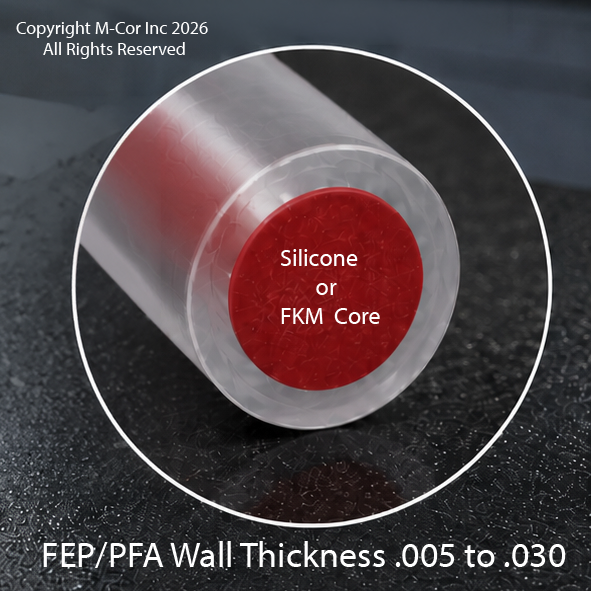
Teflon® encapsulated O-rings combine an elastomer core with a clear or translucent FEP or PFA fluoropolymer jacket. First, the elastomer core provides compression and recovery. In addition, the FEP or PFA jacket provides chemical resistance and a clean sealing barrier.
However, not every Teflon® encapsulated O-ring is made, measured, or documented the same way. Therefore, buyers should look beyond price. They should ask how the material was controlled, how the part was formed, how the seal was measured, and what tolerance standard applies.
At M-Cor Inc., one major advantage is in-house material control. As a result, M-Cor controls more of the process before the O-ring is even formed.
Related M-Cor Resources
Use this guide with M-Cor’s main product, tolerance, material, and installation resources. As a result, engineers and buyers can connect manufacturing method with product selection.
What Are Teflon® Encapsulated O-Rings?
Teflon® encapsulated O-rings are composite seals. They use an elastomer core inside a clear or translucent FEP or PFA fluoropolymer jacket.
As a result, the outer jacket helps resist aggressive chemicals, while the core supplies elastic sealing force. This design often works where standard rubber O-rings may fail because of chemical attack, elevated temperature, cleaning, purity requirements, or demanding equipment conditions.
In addition, engineers often specify these seals in chemical processing, food, pharmaceutical, bioprocessing, semiconductor, filtration, pump, valve, and other critical industrial applications.
How M-Cor Manufactures Teflon® Encapsulated O-Rings
At M-Cor, the process starts before encapsulation. First, M-Cor reviews the application. Next, we control the material of construction. Then, we match the jacket, size, tolerance, weld, and inspection plan to the application.
1. Application Review
First, M-Cor reviews temperature, chemistry, pressure, installation method, tolerance needs, and documentation requirements.
2. Material Control
Next, M-Cor controls key elastomer materials and extrusion behavior in-house. Therefore, the core is not treated as a commodity input.
3. Core Selection
Then, M-Cor selects the elastomer core. Silicone, FKM, Viton®, EPDM, hollow core, or specialty compounds may fit the application.
4. Jacket Selection
Afterward, M-Cor selects FEP or PFA. FEP fits many chemical applications. However, PFA may fit higher temperature or higher purity needs.
5. Encapsulation
Next, the fluoropolymer jacket is formed around the elastomer core. As a result, the jacket helps protect the core from direct chemical attack.
6. Forming and Welding
Then, the seal is formed to size. Many encapsulated O-rings use cut-to-length construction and welding rather than standard rubber molding.
7. Finishing
In addition, M-Cor finishes the seal to reduce rough edges, protrusions, or surface conditions that could affect installation.
8. Inspection
Finally, M-Cor inspects the finished O-ring. Therefore, dimensional control, surface condition, and customer requirements can be reviewed before shipment.
9. Documentation
Additionally, M-Cor can supply inspection and certification records when required. As a result, the buyer receives evidence, not only a part.
Why In-House Material Control Improves Quality
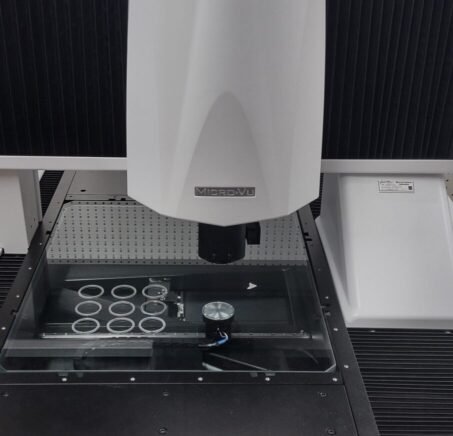
Precision tolerance starts before the O-ring is finished. In fact, tolerance control depends heavily on the consistency of the core material.
For this reason, M-Cor’s in-house material and extrusion capability gives customers a real quality advantage. When M-Cor controls the elastomer core material internally, we can better manage dimensions, hardness, recovery, lot behavior, and consistency.
Consequently, M-Cor does not have to accept every limitation created by an outside material source. Instead, our team can adjust, review, and control the process closer to the source. This approach supports precision tolerances, repeatable manufacturing, and higher confidence in the finished Teflon® encapsulated O-ring.
Teflon® Encapsulated O-Ring Tolerances
Many buyers compare Teflon® encapsulated O-rings to standard molded rubber O-rings. However, that comparison can create confusion because many encapsulated O-rings are cut-to-length and welded.
For this reason, tolerance should be reviewed before the order is placed. M-Cor publishes tolerance guidance so engineers, buyers, and distributors can understand what dimensional expectation applies.
Consequently, tolerance is not just a technical detail. It affects installation, sealing performance, receiving inspection, and customer confidence.
Price and Teflon® Encapsulated O-Ring Quality
Low price may look attractive at purchase time. However, in a critical system, the lowest-priced seal may not be the lowest-cost seal.
When buyers treat Teflon® encapsulated O-rings as commodity parts, important details may receive less attention. For example, material control, in-house extrusion, inspection time, dimensional documentation, and tolerance transparency may be reduced.
As a result, the buyer may save a small amount upfront. Later, however, downtime, repeat failures, inspection disputes, or lost trust can cost much more.
Simple rule: Pay a little more when you specify documented quality, or pay more later for low-priced commodity products.
The M-Cor Difference
M-Cor Inc. has manufactured Teflon® encapsulated O-rings and related sealing products since 1987. Therefore, our focus is not only on supplying a seal. We also control the process behind that seal.
In addition, M-Cor supports demanding applications where chemical resistance, source accountability, dimensional control, installation care, and documentation matter.
- In-house elastomer material and extrusion control
- Reduced dependence on outside vendors for critical core construction
- FEP and PFA encapsulated O-ring capability
- Silicone, FKM, Viton®, EPDM, hollow core, and specialty core options
- Published tolerance guidance
- Installation guidance for FEP and PFA jacketed seals
- Inspection and documentation support
- Engineering-focused customer support
What This Means for the Buyer
Better source control helps reduce uncertainty. Therefore, the buyer receives more than a replacement part. The buyer receives a documented sealing product from a U.S. manufacturer with direct technical support.
Common Applications for Teflon® Encapsulated O-Rings
Engineers use Teflon® encapsulated O-rings where standard O-rings may not provide enough chemical resistance, cleanliness, tolerance control, or long-term sealing reliability.
Chemical Processing
FEP and PFA jackets help protect the elastomer core from aggressive chemicals, solvents, and cleaning fluids.
Food and Beverage
In addition, encapsulated seals can support clean sealing surfaces where material compatibility and sanitation matter.
Pharmaceutical and Bioprocess
These applications often require material control, documentation, and sealing reliability under cleaning or sterilization conditions.
Semiconductor
Semiconductor systems may require high-purity materials, chemical resistance, dimensional control, and consistent documentation.
Pump, Valve, and Filtration
Meanwhile, process equipment often requires seals that resist chemicals while maintaining compression and recovery.
Critical Equipment
Finally, encapsulated O-rings help protect applications where downtime, leakage, or repeat failure carries a high cost.
Teflon® Encapsulated O-Rings FAQ
Are Teflon® encapsulated O-rings molded?
Some designs use molding. However, many encapsulated O-rings use cut-to-length construction and welding. Therefore, buyers should confirm tolerance expectations before ordering.
Why does in-house material control matter?
In-house material control helps M-Cor manage core consistency, extrusion quality, hardness, and dimensional behavior. As a result, the finished O-ring can have better process control.
Why use FEP or PFA?
FEP and PFA provide a fluoropolymer barrier with strong chemical resistance. In addition, these materials help protect the elastomer core from direct chemical exposure.
Why does installation matter?
Encapsulated O-rings need careful installation. Sharp edges, twisting, overstretching, or improper handling can damage the FEP or PFA jacket.
Should I choose the lowest price?
Price matters. However, in critical applications, quality, tolerance, in-house material control, and source accountability should come before price alone.
Specify Quality Before Failure Specifies the Cost
When a Teflon® encapsulated O-ring protects a critical application, the real question is not only what the part costs. Instead, the question is what happens if the part fails.
Therefore, if quality, tolerance, in-house material control, installation support, and documentation matter, contact M-Cor before the next seal problem becomes downtime.