
Compression Set Implications for Teflon® Encapsulated O-Rings
Why core material, Shore A hardness, filler content, and supplier quality matter.
Teflon® encapsulated O-rings are used in mechanical systems where chemical resistance, sealing force, and long-term reliability are required. However, the FEP or PFA jacket is only part of the design. The elastomer core also plays a critical role.
Therefore, engineers and buyers should understand two important core properties: compression set and Shore A hardness. Together, these properties help explain how the seal responds to compression, recovery, and load over time.
What Compression Set Means
Compression set is the permanent deformation that remains after an elastomer has been compressed and then released.
In simple terms, compression set shows how well the core material can recover after being held under load. If the elastomer does not recover well, the O-ring may lose sealing force. As a result, leakage, loss of compression, or shorter seal life may occur.
In a Teflon® encapsulated O-ring, the FEP or PFA jacket provides chemical resistance. However, the elastomer core provides much of the sealing force. Therefore, core quality cannot be ignored.
Low Compression Set
Generally supports better recovery and longer sealing performance.
High Compression Set
May reduce sealing force after the O-ring has been compressed over time.
Core Quality
Material formulation, filler content, hardness, and curing all affect performance.
How Compression Set Is Measured
Compression set is commonly measured by compressing a standard elastomer specimen between two parallel plates under specified conditions of time and temperature. After decompression, the specimen is allowed to recover. Then, the remaining permanent deformation is measured.
The result is expressed as a percentage of the original thickness. Standardized methods, including ASTM D395 and ISO 815, are commonly referenced for compression set testing.
Engineering note: Compression set test data is useful, but final seal performance still depends on application conditions, groove design, squeeze, media, temperature, and time under load.
Shore A Hardness and Durometer
Shore A hardness measures an elastomer’s resistance to indentation. It gives engineers a practical indication of stiffness and flexibility.
Shore A hardness is measured with a durometer gage. The gage applies a controlled force through an indenter tip pressed against the elastomer. The depth of indentation is converted into a Shore A value. Higher Shore A numbers indicate a harder material.
For encapsulated O-rings, hardness matters because the core must provide sealing force while still allowing compression and recovery. Therefore, the correct hardness depends on the application, gland design, pressure, temperature, and installation method.
Solid Silicone Core
Typical composite hardness: 85–90 Shore A
Solid Viton® / FKM Core
Typical composite hardness: 90–95 Shore A
Hollow Silicone Core
Typical composite hardness: 75–80 Shore A
Note: Hollow core or tubing constructions may reduce effective durometer by approximately 10%. Final behavior depends on the actual jacket, wall thickness, core geometry, and application.
Core Material and Jacket Construction
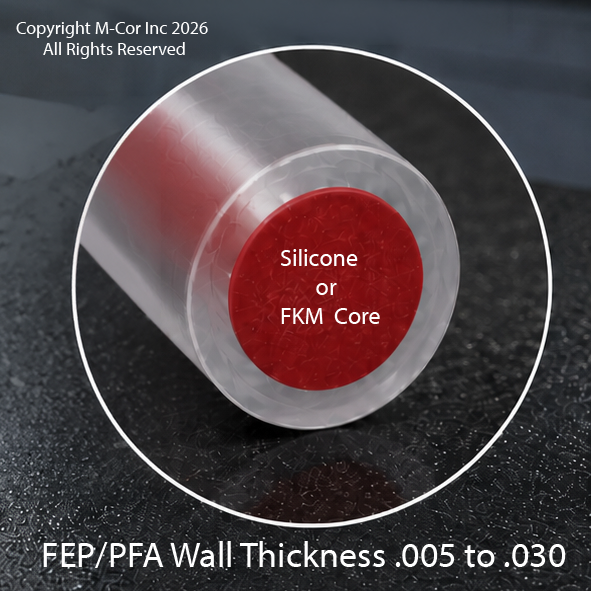
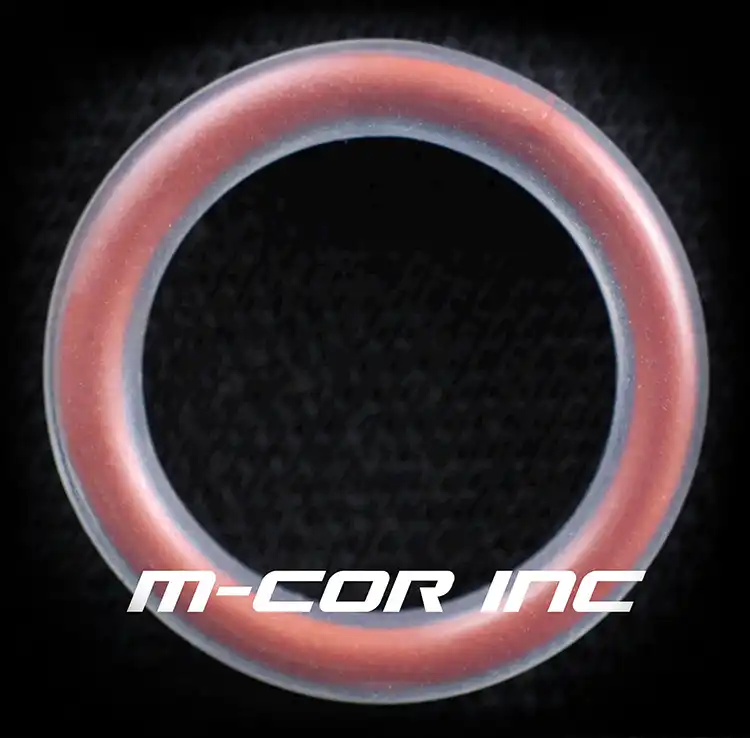
A Teflon® encapsulated O-ring is a composite seal. The clear FEP or PFA jacket surrounds the entire elastomer core. As a result, the process media contacts the fluoropolymer jacket, not the core directly.
However, the core still matters. If the core takes excessive compression set, becomes too stiff, or lacks recovery, the seal may lose force even when the jacket remains chemically resistant.
- FEP/PFA jacket provides chemical resistance.
- Silicone or FKM core provides sealing force.
- Core recovery affects long-term seal reliability.
- Wall thickness, core hardness, and groove design must work together.
The Role of Elastomer Fillers
Elastomer filler content can significantly affect compression set and Shore A hardness. Fillers may improve certain properties. However, excessive filler use can reduce recovery, increase compression set, or change the expected hardness of the material.
In cost-driven manufacturing, high filler content may be used to reduce material cost. However, that lower material cost can create a higher risk in service. As a result, the O-ring may become too stiff, too soft, or less capable of maintaining sealing force over time.
Quality warning: A low-price encapsulated O-ring can hide material compromises. If the core formulation is poor, the finished seal may still look acceptable but perform poorly.
Balancing Quality and Cost
Price matters. However, in critical sealing applications, the lowest-priced O-ring is not always the lowest-cost choice.
Some manufacturers may reduce cost by using lower-quality elastomer formulations, excessive fillers, limited inspection, or weak documentation. At first, this may reduce the purchase price. Later, however, the cost may appear as downtime, leakage, repeat failure, or lost customer confidence.
Therefore, selecting the right elastomer formulation is essential to the performance of Teflon® encapsulated O-rings. A properly selected core supports compression, recovery, hardness, and long-term sealing force.
Simple rule: Pay a little more when you specify documented quality, or pay more later for low-priced commodity products.
The M-Cor Difference
M-Cor Inc. manufactures Teflon® encapsulated O-rings with attention to material selection, core behavior, jacket construction, dimensional control, and final inspection.
In addition, M-Cor supports engineers, buyers, and distributors who may not have deep elastomer or high-performance seal knowledge. As a result, we focus on clear explanations, published guidance, and practical support.
- Silicone, Viton®/FKM, EPDM, hollow core, and specialty core options
- FEP and PFA jacket selection
- Published tolerance guidance
- Installation support
- Inspection and documentation support
- U.S.-based manufacturing and direct technical assistance

Why Compression Set Matters in the Field
Long-Term Sealing
Better recovery helps the seal maintain force after compression.
Temperature Exposure
Heat can increase compression set and reduce seal life if the core is not suitable.
Chemical Service
The jacket resists media, but the core must still support compression and recovery.
Installation
Overstretching, twisting, or poor groove design can reduce expected performance.
Inspection
Hardness and dimensional review help confirm that the correct seal was supplied.
Total Cost
Low-price material can cost more later if leakage or downtime occurs.
Referenced Test Methods
Compression set and hardness are commonly evaluated using recognized test methods. These standards help provide consistency when comparing elastomer properties.
ASTM D395
Standard test method for rubber property: compression set.
ISO 815
Rubber, vulcanized or thermoplastic: determination of compression set.
ASTM D2240
Standard test method for rubber property: durometer hardness.
Compression Set FAQ
What is compression set?
Compression set is the permanent deformation that remains after an elastomer has been compressed and then released. Lower compression set generally means better recovery.
Why does compression set matter in encapsulated O-rings?
The FEP or PFA jacket provides chemical resistance, but the elastomer core provides sealing force. Therefore, poor core recovery can reduce long-term sealing performance.
What is Shore A hardness?
Shore A hardness measures an elastomer’s resistance to indentation. It helps indicate stiffness, flexibility, and compression behavior.
Can filler content affect seal quality?
Yes. Excessive filler content can affect hardness, recovery, and compression set. As a result, the seal may not perform as expected in demanding applications.
Should price be the main factor?
Price is important. However, compression set, hardness, material quality, inspection, and documentation should also be considered in critical sealing applications.
Need Help Selecting the Right Encapsulated O-Ring Core?
M-Cor can review your application, temperature, media, groove design, installation method, and documentation requirements before production.
Therefore, when core quality, compression set, hardness, and long-term sealing force matter, contact M-Cor before a seal problem becomes downtime.
Teflon® and Viton® are registered trademarks of their respective owners. Use of these names is for material identification only.